Texas Real Estate Investor InsightsHow Much Earnest Money Should I Put Down?When purchasing Texas investment property, one of the first numbers a buyer may have to decide is the earnest money.

Dated: June 29 2026
Views: 4
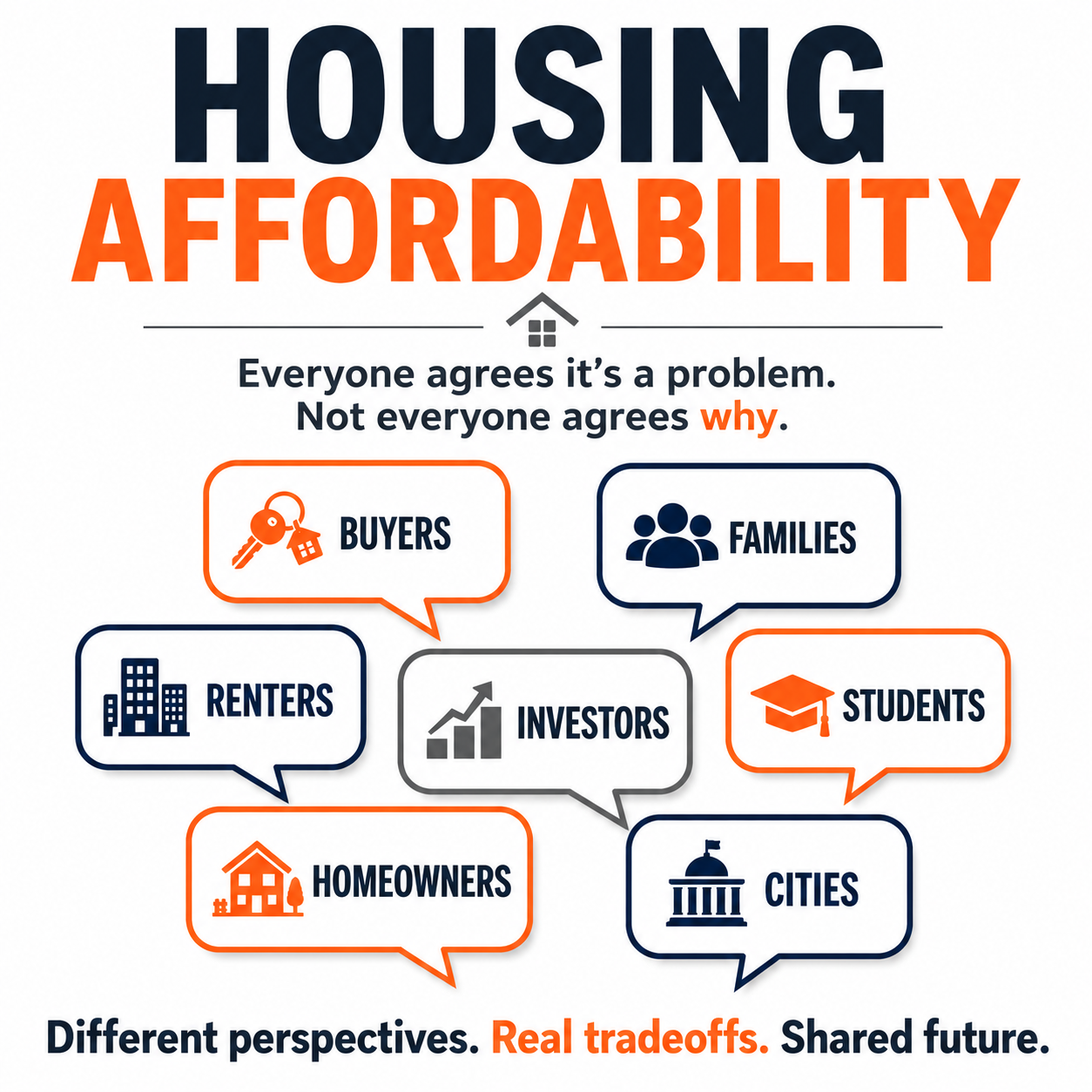
Housing affordability has become one of the few issues that seems capable of generating agreement from almost everyone.
Homebuyers worry about rising prices.
Renters worry about rising rents.
Developers point to rising construction costs.
Local governments face pressure to accommodate growth while maintaining infrastructure and quality of life.
And communities across the country continue to debate what new housing should look like—and where it should be built.
The challenge is that while most people agree housing affordability is a problem, there is far less agreement about what is causing it.
Is there simply not enough housing?
Have institutional investors made the problem worse?
Are regulations and permitting requirements slowing construction?
Do interest rates matter more than housing supply?
Or is affordability the result of several different pressures arriving at the same time?
Those questions sit at the center of one of the most significant housing discussions taking place in Washington today.
Recently, Congress advanced a broad package of housing legislation aimed at addressing affordability through a variety of approaches. The proposals include measures designed to encourage new housing construction, support manufactured and modular housing, promote redevelopment of underused commercial properties, reduce barriers to development, and place certain restrictions on large institutional investors purchasing additional single-family homes.
While the specific policies vary, the underlying goal is straightforward:
Make housing easier to build.
Realtor.com estimates the United States faces a housing supply gap of approximately 4 million homes.
Harvard University's Joint Center for Housing Studies reports that housing affordability challenges continue to affect both renters and homeowners nationwide.
Record numbers of renters are considered cost-burdened, meaning a significant portion of their income goes toward housing expenses.
Housing economists continue to debate the relative impact of supply shortages, financing costs, construction costs, investor activity, and local regulations, but most agree all play a role in today's affordability challenges.
That objective stems from a reality that many housing economists have highlighted for years.
The United States has not produced enough housing to keep pace with population growth and household formation in many parts of the country.
If housing is scarce, basic economics suggests prices rise.
Build more housing, and affordability should improve.
At least in theory.
The challenge is that housing is rarely that simple.
Housing affordability is often discussed as though it were a single problem.
In reality, it may be several different problems sharing the same name.
A first-time homebuyer searching for an entry-level house may define affordability differently than a college student looking for rental housing.
A retiree on a fixed income may view affordability differently than a growing family looking for more space.
An investor may view affordability through the lens of housing supply and market demand.
And a local government may be forced to consider affordability alongside infrastructure, public safety, schools, utilities, and long-term growth planning.
Understanding those competing priorities may be just as important as understanding housing prices themselves.
A home is not a product that can be manufactured in one place and instantly delivered somewhere else.
Housing is shaped by local zoning rules, infrastructure capacity, utility systems, environmental regulations, labor availability, land costs, financing conditions, and community priorities.
In other words:
Housing may be debated nationally, but it is ultimately built locally.
That reality creates an interesting question.
Even if Washington successfully encourages more housing construction, how much influence does the federal government actually have over affordability?
A federal policy can create incentives.
It can provide funding.
It can remove obstacles.
But it cannot decide where a neighborhood grows.
It cannot determine whether local residents support increased density.
It cannot expand a water system, build a road, or approve a subdivision.
Those decisions largely remain in the hands of states, counties, cities, and local communities.
Which may explain why housing affordability remains such a persistent challenge.
The issue is not simply about building more homes.
It is about balancing affordability, infrastructure, property rights, neighborhood character, growth, and quality of life—all at the same time.
And that is where the conversation becomes far more complicated than a single piece of legislation.
Because affordability sounds simple until you ask:
What kind of affordability?
For whom?
At what cost?
And who gets to decide?
Over the years, I've worked with first-time buyers struggling to purchase their first home, investors looking to build long-term wealth, parents searching for housing for college students, renters hoping for more affordable options, and longtime homeowners concerned about changes in their neighborhoods.
The reality is that housing policy affects all of them.
And those interests don't always align.
That's part of what makes housing affordability such a difficult issue to solve.
In Part 2, we'll look at one of the biggest questions driving the national housing debate:
Is housing affordability primarily a supply problem—or an investor problem?
#HousingPolicy #HousingAffordability #BCSRealEstate #NextHomeBCS #DannySellsBCS

Native Texan. Fightin' Texas Aggie Class of '94. A few years back when purchasing our home here in BCS while still living in NYC, I found that buying a home can be sometimes confusing and frustrat....
Texas Real Estate Investor InsightsHow Much Earnest Money Should I Put Down?When purchasing Texas investment property, one of the first numbers a buyer may have to decide is the earnest money.
Texas Real Estate Investor InsightsShould I Buy an Investment Property That Already Has a Tenant?Buying an investment property that already has a tenant can sound like an ideal arrangement.You close
Texas Real Estate Investor InsightsCan I Use a 1031 Exchange When I Sell My Investment Property?If you're planning to sell an investment property and purchase another, one question may come up early
Texas Real Estate Investor InsightsShould I Buy My Investment Property Through an LLC?Buying an investment property raises an important question early in the process: Should you buy the property in
The accuracy of all information, regardless of source, including but not limited to open house information, square footages and lot sizes, is deemed reliable but not guaranteed and should be personally verified through personal inspection by and/or with the appropriate professionals. The data contained herein is copyrighted by Houston Realtors Information Service, Inc. and is protected by all applicable copyright laws. Any unauthorized dissemination of this information is in violation of copyright laws and is strictly prohibited. Copyright 2026 Houston Association of REALTORS, Inc. All rights reserved. Last Update: September 24, 2026 9:10 AM UTC The information being provided by Houston Association of REALTORS, Inc. is for the consumer's personal, non-commercial use and may not be used for any purpose other than to identify prospective properties consumers may be interested in purchasing. Any information relating to real estate for sale referenced on this web site comes from the Internet Data Exchange (IDX) program of the Houston Association of REALTORS, Inc. This web site may reference real estate listing(s) held by a brokerage firm other
than the broker and/or agent who owns this web site.
The information being provided by Houston Association of REALTORS, Inc. is for the consumer's personal, non-commercial use and may not be used for any purpose other than to identify prospective properties consumers may be interested in purchasing. Any information relating to real estate for sale referenced on this web site comes from the Internet Data Exchange (IDX) program of the Houston Association of REALTORS, Inc. This web site may reference real estate listing(s) held by a brokerage firm other
than the broker and/or agent who owns this web site.
 © 2026 Bryan College Station Regional Association of Realtors. All rights reserved. Information deemed to be reliable but not guaranteed. The data relating to real estate for sale on this website comes in part from the Broker Reciprocitysm Program. Real estate listings held by brokerage firms other than NextHome Realty Solutions BCS are marked with the BR logo and detailed information about them includes the name of the listing brokers. Listing broker has attempted to offer accurate data, but
buyers are advised to confirm all items. Information last updated on September 24, 2026 8:00 AM UTC
Show More...
© 2026 Bryan College Station Regional Association of Realtors. All rights reserved. Information deemed to be reliable but not guaranteed. The data relating to real estate for sale on this website comes in part from the Broker Reciprocitysm Program. Real estate listings held by brokerage firms other than NextHome Realty Solutions BCS are marked with the BR logo and detailed information about them includes the name of the listing brokers. Listing broker has attempted to offer accurate data, but
buyers are advised to confirm all items. Information last updated on September 24, 2026 8:00 AM UTC
Show More...
