Texas Real Estate Investor InsightsHow Much Earnest Money Should I Put Down?When purchasing Texas investment property, one of the first numbers a buyer may have to decide is the earnest money.

Dated: June 1 2026
Views: 8
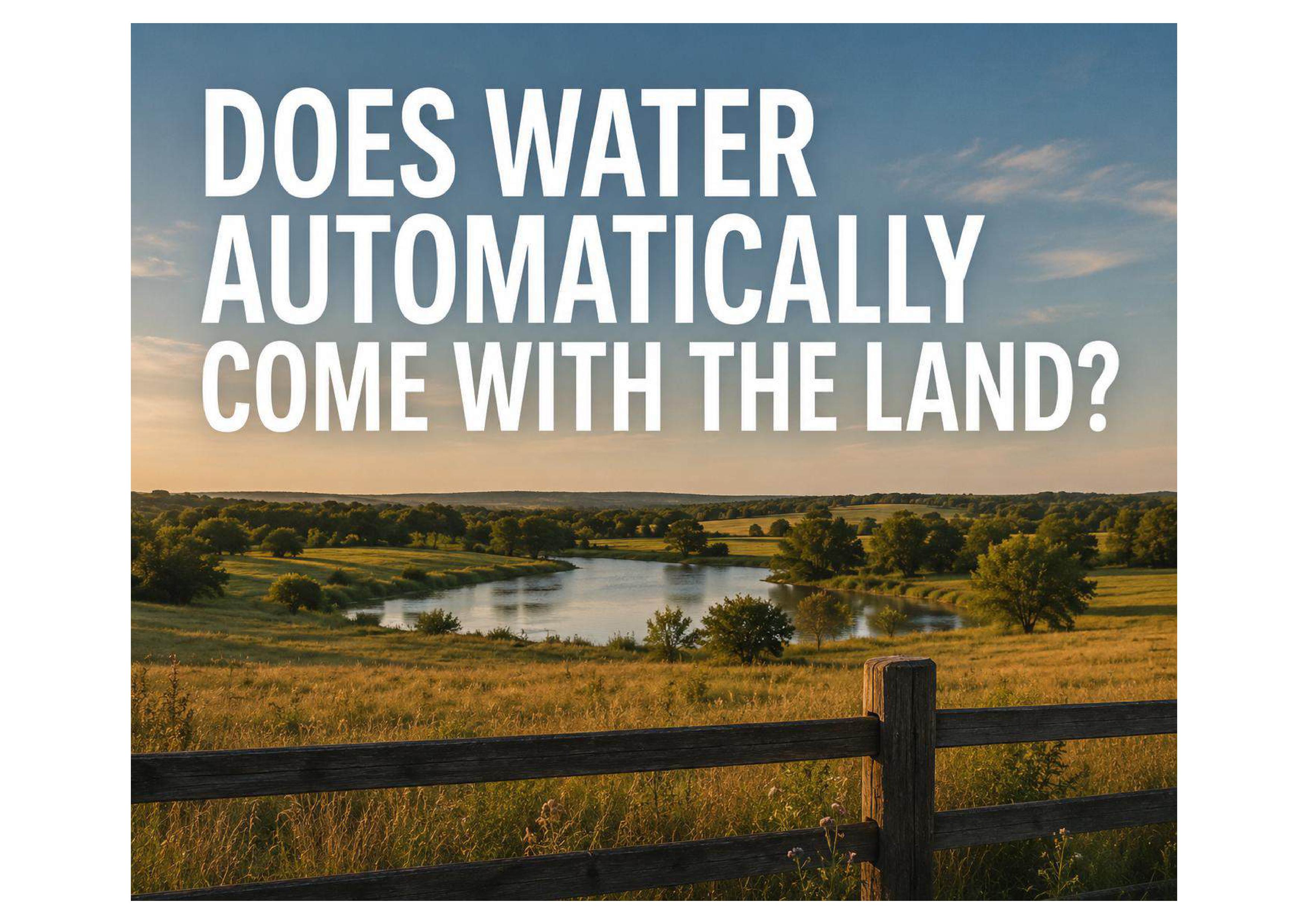
A creek. A pond. A water well.
Most buyers see those features and assume the same thing:
"The property has water."
In Texas, that's not always the right question.
The better question is:
"What rights actually come with that water?"
Whether you're looking at acreage, a ranch, a homesite, or future development property, water can have a major impact on value, usability, and long-term costs. But different types of water are governed by different rules.
Before we talk about legislation, drought planning, or future water challenges, it's important to understand the basics.
The first thing buyers should know is that Texas generally separates water into two categories:
Surface Water — rivers, creeks, streams, lakes, and reservoirs.
Groundwater — water beneath the surface, typically accessed through wells.
That distinction matters because the rules are very different.
A property may have a creek, a pond, a well, and a nearby waterline. Those sound like four sources of water, but each raises different legal and practical questions.
The key takeaway:
The presence of water is not the same thing as the right to use it.
Surface water and groundwater may both be water, but Texas treats them very differently.
Surface water is generally regulated by the State of Texas. Just because a creek or stream crosses a property doesn't automatically mean the owner can freely pump, divert, or use that water however they choose.
Groundwater is different.
Texas follows what's known as the Rule of Capture, which generally allows landowners to access groundwater beneath their property. However, many areas are also regulated by Groundwater Conservation Districts, which may impose permitting, spacing, and pumping requirements.
In other words, owning land may give you access to groundwater, but that access is not always unlimited.
Buyers often see a well as proof that the water issue is solved.
Not necessarily.
Important questions still include:
How much water does it produce?
What is the water quality?
Can it support the property's intended use?
A well that easily serves a single home may not be adequate for livestock, irrigation, or future development.
Water features can add beauty, recreation, and value to a property.
But they don't all provide the same practical benefit.
A pond may depend entirely on rainfall. A creek may flow year-round or only after storms. A stock tank that supports livestock in wet years may struggle during drought.
What matters isn't just whether water exists today.
It's whether the water is reliable for the buyer's intended use.
Even properties served by public utilities deserve a closer look.
A waterline near a property doesn't automatically mean water service is available, affordable, or adequate for the intended use.
For development property, those details can significantly impact feasibility and cost.
Two properties can look nearly identical on paper and have very different values because of water.
Reliable water access can support homes, livestock, agriculture, recreation, and future development.
Uncertain water access can limit use, increase costs, and create risk.
That's why water should be part of every buyer's due diligence process—especially when purchasing rural land, acreage, farms, ranches, or development tracts.
Water can add tremendous value to a property.
It can also create limitations that aren't obvious at first glance.
That's why one of the most important questions a buyer can ask isn't:
"Does this property have water?"
It's:
"What rights, access, and limitations come with it?"
In Texas real estate, understanding that distinction is the foundation for understanding water rights.
And it's the first step toward understanding why water availability is becoming one of the most important growth, development, and property-rights issues facing the state.
In Part 2, we'll look at why decisions being made today could affect Texas property owners for decades to come.
#WaterRights #DannySellsBCS #NextHomeBCS #TexasWater #HumansOverHouses

Native Texan. Fightin' Texas Aggie Class of '94. A few years back when purchasing our home here in BCS while still living in NYC, I found that buying a home can be sometimes confusing and frustrat....
Texas Real Estate Investor InsightsHow Much Earnest Money Should I Put Down?When purchasing Texas investment property, one of the first numbers a buyer may have to decide is the earnest money.
Texas Real Estate Investor InsightsShould I Buy an Investment Property That Already Has a Tenant?Buying an investment property that already has a tenant can sound like an ideal arrangement.You close
Texas Real Estate Investor InsightsCan I Use a 1031 Exchange When I Sell My Investment Property?If you're planning to sell an investment property and purchase another, one question may come up early
Texas Real Estate Investor InsightsShould I Buy My Investment Property Through an LLC?Buying an investment property raises an important question early in the process: Should you buy the property in
The accuracy of all information, regardless of source, including but not limited to open house information, square footages and lot sizes, is deemed reliable but not guaranteed and should be personally verified through personal inspection by and/or with the appropriate professionals. The data contained herein is copyrighted by Houston Realtors Information Service, Inc. and is protected by all applicable copyright laws. Any unauthorized dissemination of this information is in violation of copyright laws and is strictly prohibited. Copyright 2026 Houston Association of REALTORS, Inc. All rights reserved. Last Update: September 23, 2026 3:19 AM UTC The information being provided by Houston Association of REALTORS, Inc. is for the consumer's personal, non-commercial use and may not be used for any purpose other than to identify prospective properties consumers may be interested in purchasing. Any information relating to real estate for sale referenced on this web site comes from the Internet Data Exchange (IDX) program of the Houston Association of REALTORS, Inc. This web site may reference real estate listing(s) held by a brokerage firm other
than the broker and/or agent who owns this web site.
The information being provided by Houston Association of REALTORS, Inc. is for the consumer's personal, non-commercial use and may not be used for any purpose other than to identify prospective properties consumers may be interested in purchasing. Any information relating to real estate for sale referenced on this web site comes from the Internet Data Exchange (IDX) program of the Houston Association of REALTORS, Inc. This web site may reference real estate listing(s) held by a brokerage firm other
than the broker and/or agent who owns this web site.
 © 2026 Bryan College Station Regional Association of Realtors. All rights reserved. Information deemed to be reliable but not guaranteed. The data relating to real estate for sale on this website comes in part from the Broker Reciprocitysm Program. Real estate listings held by brokerage firms other than NextHome Realty Solutions BCS are marked with the BR logo and detailed information about them includes the name of the listing brokers. Listing broker has attempted to offer accurate data, but
buyers are advised to confirm all items. Information last updated on September 23, 2026 3:45 AM UTC
Show More...
© 2026 Bryan College Station Regional Association of Realtors. All rights reserved. Information deemed to be reliable but not guaranteed. The data relating to real estate for sale on this website comes in part from the Broker Reciprocitysm Program. Real estate listings held by brokerage firms other than NextHome Realty Solutions BCS are marked with the BR logo and detailed information about them includes the name of the listing brokers. Listing broker has attempted to offer accurate data, but
buyers are advised to confirm all items. Information last updated on September 23, 2026 3:45 AM UTC
Show More...
