Texas Real Estate Investor InsightsHow Much Earnest Money Should I Put Down?When purchasing Texas investment property, one of the first numbers a buyer may have to decide is the earnest money.

Dated: July 1 2026
Views: 2
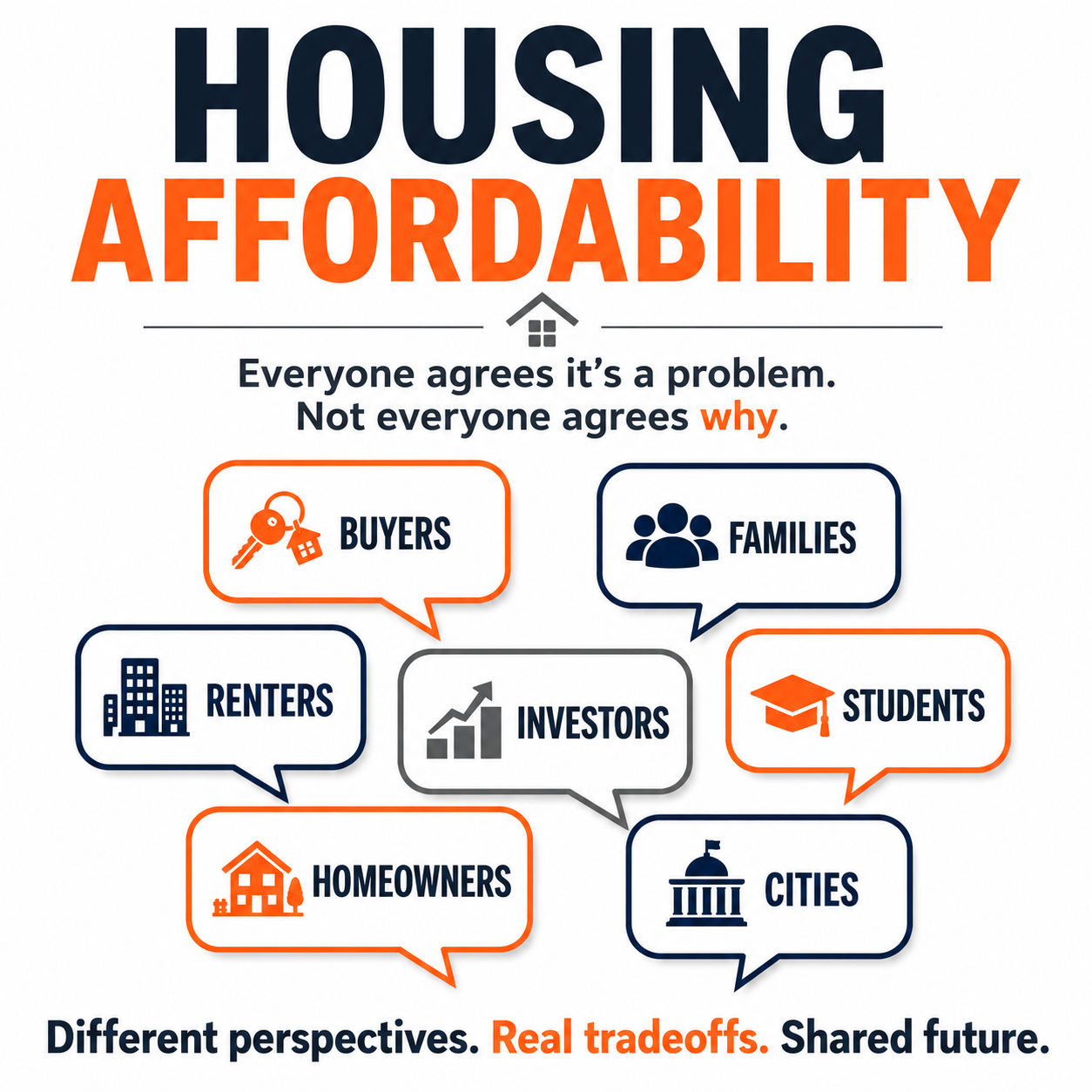
Housing affordability has become one of the most discussed issues in America.
Yet despite years of debate, there is still surprisingly little agreement about what is causing the problem.
Ask ten people why housing has become less affordable, and you'll probably hear ten different answers.
But most of those answers tend to fall into two broad categories.
One focuses on investors.
The other focuses on housing supply.
Most people agree housing affordability has become a growing concern.
Home prices have risen.
Rents have increased.
Many first-time buyers feel increasingly priced out of the market.
But while there is broad agreement that affordability is a challenge, there is far less agreement about why.
For many people, the answer seems obvious.
If housing has become less affordable, it must be because investors are purchasing homes that would otherwise be available to owner-occupants.
The argument gained traction during and after the pandemic, when institutional investors became increasingly visible in many housing markets.
Stories emerged of investment firms purchasing large numbers of homes, often making cash offers and competing directly with traditional buyers.
For prospective homeowners already struggling with rising prices and higher mortgage rates, it was easy to understand the frustration.
Every home purchased by an investor was one less home available to a family looking to buy.
Supporters of this viewpoint argue that increased investor activity reduces inventory, increases competition, and places additional upward pressure on prices.
It's also one reason recent federal housing proposals have included provisions aimed at limiting certain future acquisitions by large institutional investors.
For many Americans, investor activity feels like a direct and visible contributor to housing affordability challenges.
But others argue the story is much larger than that.
Housing economists often point to a different issue.
Their concern is not who is buying homes.
Their concern is whether there are enough homes to begin with.
For years, many researchers have argued that the United States has underbuilt housing relative to population growth and household formation.
At the same time, construction costs have increased.
Labor shortages have affected the building trades.
Land costs have risen in many markets.
Permitting and approval processes can add time and expense to new development.
When supply struggles to keep pace with demand, prices tend to rise.
Under this view, investor activity may influence certain markets, but it is not the primary driver of affordability challenges.
The larger issue is a simple mismatch between the number of people seeking housing and the number of housing units available.
If that analysis is correct, limiting investor purchases alone would do little to solve affordability unless more housing is built as well.
One reason housing affordability remains such a difficult issue is that the debate is often framed as an either-or question.
Either investors are responsible.
Or housing supply is responsible.
Reality may be more complicated.
Consider a market where:
Housing inventory is limited.
Construction costs remain elevated.
Interest rates reduce purchasing power.
Population growth continues.
Investor activity remains strong.
In that environment, multiple pressures may be acting on affordability at the same time.
A shortage of housing can push prices higher.
Investor competition can increase demand for available properties.
Higher financing costs can reduce affordability even if prices stabilize.
Construction costs can make it difficult to build less expensive housing.
Each factor influences the others.
Which makes identifying a single cause difficult.
And identifying a single solution even harder.
And depending on which explanation people find most persuasive, they often support very different solutions.
Even if communities agree that affordability should improve, they may not agree on how to achieve it.
Some advocate for policies that encourage more housing construction.
Others focus on limiting investor activity.
Some support increased housing density.
Others prioritize preserving existing neighborhood character.
Many communities are attempting to balance all of those goals simultaneously.
That balancing act can be difficult because every housing decision involves tradeoffs.
More housing may improve affordability.
But growth can also create new demands on roads, utilities, schools, and public services.
Restrictions on investors may increase opportunities for owner-occupants.
But investment can also provide rental housing and support new development.
Neither side is entirely wrong.
And neither side appears to offer a complete solution on its own.
The question may not be whether affordability is a supply problem or an investor problem.
The question may be how communities respond when both pressures exist at the same time.
And that is where the conversation begins to move from Washington and Austin to city halls and neighborhoods across the country.
Including here in Bryan-College Station.
In Part 3, we'll look at how national and state housing debates have influenced local conversations about affordability, occupancy, growth, and neighborhood character—and why those discussions are likely to continue shaping the future of our community.
#HousingPolicy #HousingAffordability #BCSRealEstate #NextHomeBCS #DannySellsBCS

Native Texan. Fightin' Texas Aggie Class of '94. A few years back when purchasing our home here in BCS while still living in NYC, I found that buying a home can be sometimes confusing and frustrat....
Texas Real Estate Investor InsightsHow Much Earnest Money Should I Put Down?When purchasing Texas investment property, one of the first numbers a buyer may have to decide is the earnest money.
Texas Real Estate Investor InsightsShould I Buy an Investment Property That Already Has a Tenant?Buying an investment property that already has a tenant can sound like an ideal arrangement.You close
Texas Real Estate Investor InsightsCan I Use a 1031 Exchange When I Sell My Investment Property?If you're planning to sell an investment property and purchase another, one question may come up early
Texas Real Estate Investor InsightsShould I Buy My Investment Property Through an LLC?Buying an investment property raises an important question early in the process: Should you buy the property in
The accuracy of all information, regardless of source, including but not limited to open house information, square footages and lot sizes, is deemed reliable but not guaranteed and should be personally verified through personal inspection by and/or with the appropriate professionals. The data contained herein is copyrighted by Houston Realtors Information Service, Inc. and is protected by all applicable copyright laws. Any unauthorized dissemination of this information is in violation of copyright laws and is strictly prohibited. Copyright 2026 Houston Association of REALTORS, Inc. All rights reserved. Last Update: September 24, 2026 9:10 AM UTC The information being provided by Houston Association of REALTORS, Inc. is for the consumer's personal, non-commercial use and may not be used for any purpose other than to identify prospective properties consumers may be interested in purchasing. Any information relating to real estate for sale referenced on this web site comes from the Internet Data Exchange (IDX) program of the Houston Association of REALTORS, Inc. This web site may reference real estate listing(s) held by a brokerage firm other
than the broker and/or agent who owns this web site.
The information being provided by Houston Association of REALTORS, Inc. is for the consumer's personal, non-commercial use and may not be used for any purpose other than to identify prospective properties consumers may be interested in purchasing. Any information relating to real estate for sale referenced on this web site comes from the Internet Data Exchange (IDX) program of the Houston Association of REALTORS, Inc. This web site may reference real estate listing(s) held by a brokerage firm other
than the broker and/or agent who owns this web site.
 © 2026 Bryan College Station Regional Association of Realtors. All rights reserved. Information deemed to be reliable but not guaranteed. The data relating to real estate for sale on this website comes in part from the Broker Reciprocitysm Program. Real estate listings held by brokerage firms other than NextHome Realty Solutions BCS are marked with the BR logo and detailed information about them includes the name of the listing brokers. Listing broker has attempted to offer accurate data, but
buyers are advised to confirm all items. Information last updated on September 24, 2026 8:00 AM UTC
Show More...
© 2026 Bryan College Station Regional Association of Realtors. All rights reserved. Information deemed to be reliable but not guaranteed. The data relating to real estate for sale on this website comes in part from the Broker Reciprocitysm Program. Real estate listings held by brokerage firms other than NextHome Realty Solutions BCS are marked with the BR logo and detailed information about them includes the name of the listing brokers. Listing broker has attempted to offer accurate data, but
buyers are advised to confirm all items. Information last updated on September 24, 2026 8:00 AM UTC
Show More...
