Texas Real Estate Investor InsightsHow Much Earnest Money Should I Put Down?When purchasing Texas investment property, one of the first numbers a buyer may have to decide is the earnest money.
Dated: July 3 2026
Views: 7
In the first two parts of this series, we explored housing affordability from a national perspective.
We looked at efforts in Washington to address housing challenges.
We examined the ongoing debate over whether affordability is primarily a supply problem, an investor problem, or some combination of both.
But eventually every housing discussion arrives at the same place.
Local communities.
That's because housing may be debated nationally, but it is experienced locally.
People don't search for homes in the national housing market.
They search in Bryan.
Specific neighborhoods.
Specific school districts.
Specific communities.
And once a housing conversation becomes local, the questions often change.
The debate is no longer simply about affordability.
It becomes a discussion about growth.
Infrastructure.
Neighborhood character.
Property rights.
Quality of life.
And how all of those priorities fit together.
That's where housing affordability becomes much more complicated.
Because while many people agree affordable housing is important, communities don't always agree on how to achieve it—or what tradeoffs they're willing to accept along the way.
Bryan-College Station continues to experience the kind of growth many communities hope for but few achieve.
Texas A&M University remains a major driver of housing demand in the region.
New employers continue to create jobs.
Families continue to relocate here.
Developers continue to build new housing.
And local governments continue to face the challenge of planning for both today's needs and tomorrow's growth.
Most people view those trends as signs of a healthy and successful community.
At the same time, growth inevitably creates new questions.
Those questions appear in many different forms.
Discussions surrounding the future of Midtown have raised questions about redevelopment, economic activity, housing opportunities, and how different land uses fit into the long-term vision for the community.
Development around the Costco corridor has generated conversations about housing demand, traffic, infrastructure capacity, and how growth should occur as Bryan-College Station continues to expand.
Student housing, neighborhood occupancy, redevelopment projects, transportation improvements, and new residential construction may appear to be separate issues.
In reality, they are often different parts of the same conversation.
How should a growing community balance affordability, infrastructure, economic opportunity, property rights, and quality of life?
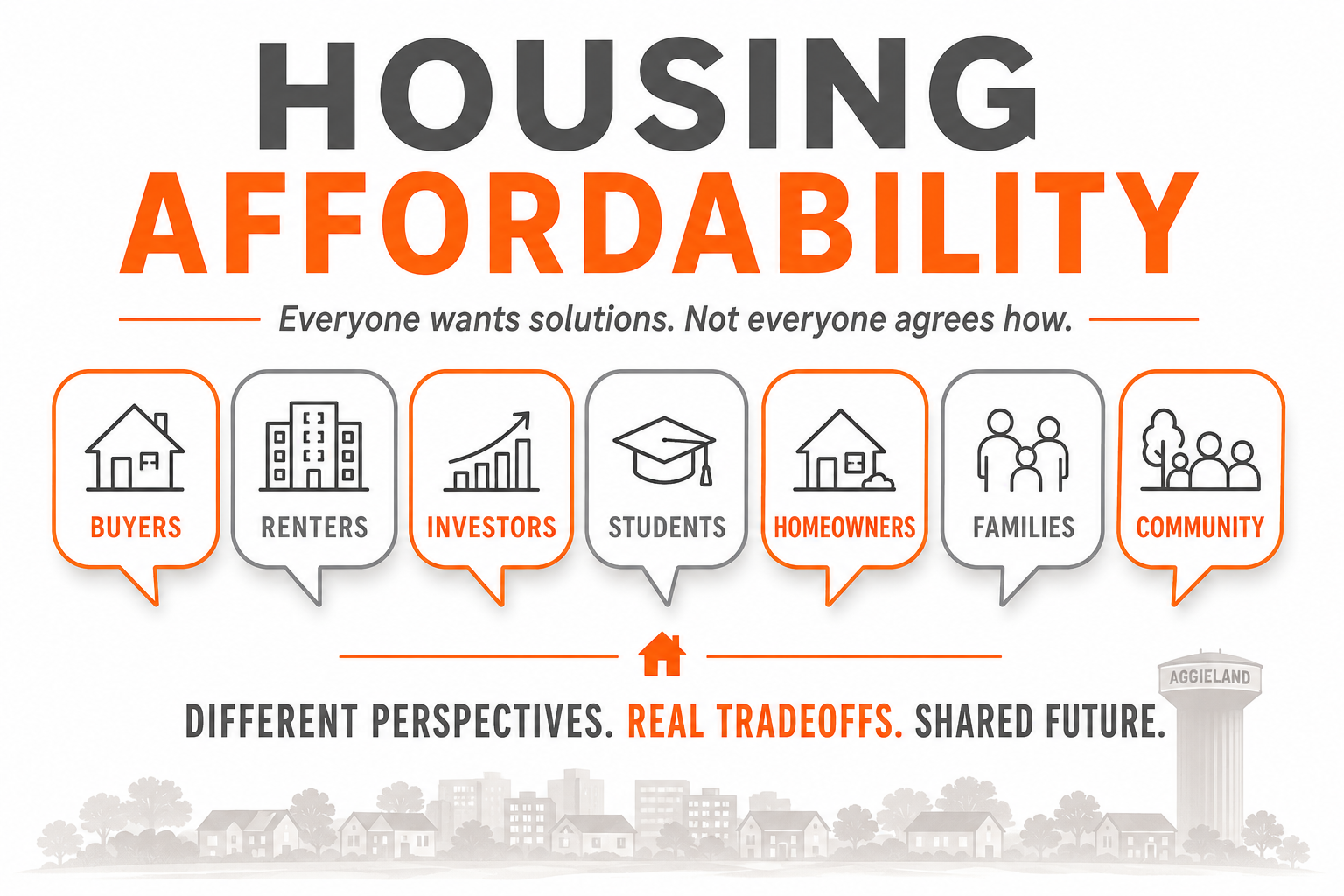
One reason housing debates can become so contentious is that people often begin with different priorities.
A young family searching for a starter home may focus on affordability and availability.
A student may focus on rental costs.
A property owner may focus on private property rights.
A longtime resident may focus on neighborhood character and quality of life.
A city government may be responsible for considering all of those interests at the same time.
Because people often define the problem differently, they frequently support different solutions.
Some advocate for higher-density housing.
Others support preserving existing development patterns.
Some focus on increasing housing supply.
Others focus on managing growth and protecting existing neighborhoods.
Many support some combination of both.
Every potential solution solves one challenge while creating another.
Building more housing may improve affordability.
It may also increase demands on roads, utilities, drainage systems, schools, and public safety services.
Preserving existing neighborhood patterns may protect community character.
It may also limit future housing options.
Encouraging additional density may create more housing opportunities.
It may also raise concerns about traffic, parking, and infrastructure capacity.
Those tradeoffs are not unique to Bryan-College Station.
Communities across the country wrestle with them every day.
The question is rarely whether tradeoffs exist.
The question is which tradeoffs a community is willing to accept.
Few housing issues illustrate competing priorities more clearly than occupancy regulations.
Supporters of occupancy limits often emphasize neighborhood stability, parking concerns, quality of life, and the desire to preserve established residential patterns.
Opponents frequently point to affordability, housing flexibility, property rights, and the ability of residents to share housing costs.
Both perspectives emerge from legitimate concerns.
Both involve real consequences.
And both reflect a broader question that sits at the center of many housing debates:
How should communities balance competing priorities when all of them matter?
The occupancy debate is only one example.
But it demonstrates how difficult housing decisions can become when multiple goals are competing for attention at the same time.
Throughout this series, we've examined housing affordability from several different angles.
We've looked at federal policy.
We've explored competing explanations for rising housing costs.
And we've considered how those larger debates eventually become local decisions.
In the end, the affordability conversation may not really be about housing at all.
It may be a conversation about community priorities.
What kind of growth do we want?
What kind of neighborhoods do we want?
What kind of housing options do we want?
And how do we balance those goals when they occasionally point in different directions?
Those aren't questions Washington can answer.
They're questions every community must answer for itself.
Including Bryan-College Station.
#HousingAffordability #CommunityPlanning #NextHomeBCS #BCSRealEstate #DannySellsBCS

Native Texan. Fightin' Texas Aggie Class of '94. A few years back when purchasing our home here in BCS while still living in NYC, I found that buying a home can be sometimes confusing and frustrat....
Texas Real Estate Investor InsightsHow Much Earnest Money Should I Put Down?When purchasing Texas investment property, one of the first numbers a buyer may have to decide is the earnest money.
Texas Real Estate Investor InsightsShould I Buy an Investment Property That Already Has a Tenant?Buying an investment property that already has a tenant can sound like an ideal arrangement.You close
Texas Real Estate Investor InsightsCan I Use a 1031 Exchange When I Sell My Investment Property?If you're planning to sell an investment property and purchase another, one question may come up early
Texas Real Estate Investor InsightsShould I Buy My Investment Property Through an LLC?Buying an investment property raises an important question early in the process: Should you buy the property in
The accuracy of all information, regardless of source, including but not limited to open house information, square footages and lot sizes, is deemed reliable but not guaranteed and should be personally verified through personal inspection by and/or with the appropriate professionals. The data contained herein is copyrighted by Houston Realtors Information Service, Inc. and is protected by all applicable copyright laws. Any unauthorized dissemination of this information is in violation of copyright laws and is strictly prohibited. Copyright 2026 Houston Association of REALTORS, Inc. All rights reserved. Last Update: September 23, 2026 3:19 AM UTC The information being provided by Houston Association of REALTORS, Inc. is for the consumer's personal, non-commercial use and may not be used for any purpose other than to identify prospective properties consumers may be interested in purchasing. Any information relating to real estate for sale referenced on this web site comes from the Internet Data Exchange (IDX) program of the Houston Association of REALTORS, Inc. This web site may reference real estate listing(s) held by a brokerage firm other
than the broker and/or agent who owns this web site.
The information being provided by Houston Association of REALTORS, Inc. is for the consumer's personal, non-commercial use and may not be used for any purpose other than to identify prospective properties consumers may be interested in purchasing. Any information relating to real estate for sale referenced on this web site comes from the Internet Data Exchange (IDX) program of the Houston Association of REALTORS, Inc. This web site may reference real estate listing(s) held by a brokerage firm other
than the broker and/or agent who owns this web site.
 © 2026 Bryan College Station Regional Association of Realtors. All rights reserved. Information deemed to be reliable but not guaranteed. The data relating to real estate for sale on this website comes in part from the Broker Reciprocitysm Program. Real estate listings held by brokerage firms other than NextHome Realty Solutions BCS are marked with the BR logo and detailed information about them includes the name of the listing brokers. Listing broker has attempted to offer accurate data, but
buyers are advised to confirm all items. Information last updated on September 23, 2026 3:45 AM UTC
Show More...
© 2026 Bryan College Station Regional Association of Realtors. All rights reserved. Information deemed to be reliable but not guaranteed. The data relating to real estate for sale on this website comes in part from the Broker Reciprocitysm Program. Real estate listings held by brokerage firms other than NextHome Realty Solutions BCS are marked with the BR logo and detailed information about them includes the name of the listing brokers. Listing broker has attempted to offer accurate data, but
buyers are advised to confirm all items. Information last updated on September 23, 2026 3:45 AM UTC
Show More...
